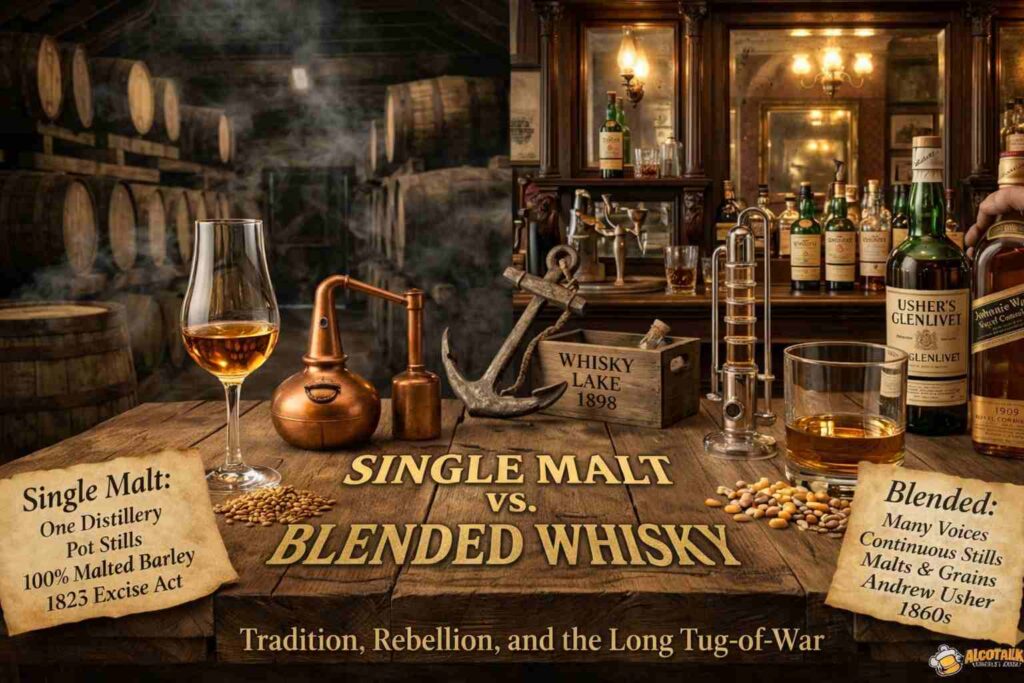
Whisky has a way of sharing its secrets, doesn’t it? Picture a Highland crofter back in 1823, sipping a dram from an illegal still, peaty smoke curling through the night. Jump ahead a few decades: a Victorian bar in Manhattan, a bottle of Glenlivet catching the gaslight—smuggled in before trains even imagined crossing oceans.
One sticks to a single voice—pure, from copper pot stills. The other? It’s more like a choir, mixing malts and grains until you get something smooth, layered, maybe even a bit mysterious. Peel back the labels, though, and history starts to spill out: royal warrants scribbled in dusty old ledgers, the “whisky lake” disaster of 1898 that nearly drowned the industry, or the 1909 Royal
Commission quietly crowns blends as everyday kings. This isn’t just about what’s in your glass. It’s rebellion, brains, and the long tug-of-war between tradition and whatever works. Why does one bottle end up locked away like a family heirloom, while another flows through every lively pub? Let’s dig deeper.
Forging Paths: The Ancestral Schisms
Whisky started out in the misty Scottish glens, but single malt and blended whisky split off early—like brothers arguing over who gets the family farm. Single malts? They’re born from malted barley and yeast, always at the same distillery. Think about Talisker’s salty Isle or Glen Grant’s sunny Speyside groves.
Blends play the diplomat—mixing those powerful malts with lighter grain whiskies from enormous column stills, smoothing things out so more people can enjoy a dram. Dig into the past, and you’ll find real drama. Illegal distillers dodged taxes until 1823, when the Excise Act finally brought single malts into the open, just as grain whisky started flooding out of the Lowlands.
If you want obscure, look up the Pattison Crash in 1898—a whisky company collapsed, leaving 1.5 million casks unsold, nearly wiping out single malt makers while the cheaper, more adaptable blends survived.
Or check the 1909 Royal Commission, which, after some clever lobbying, decided Scotch could include grain whisky—giving blends the green light and launching Johnnie Walker into global fame.
Even today, you can see the split in export numbers: in 2024, blends made up almost 60% of Scotch’s £3.2 billion sales, while single malts, though pricier, actually slipped a bit as the craft craze kept shifting. These twists shape not just taste, but fortunes.
1. What is the difference between single malt and blended whisky in their clandestine births?
Single malts started out like hermits in the Highlands—distilled in pot stills, 100% malted barley, one distillery only. Picture monks in 1494, experimenting with barley and yeast; then jump to the 1820s, when Royal Brackla landed a royal warrant for “pure malt,” untouched by Lowland grains.
Blended whisky came from a different angle—a practical Lowlander’s idea. In the 1860s, Andrew Usher took the deep flavor of malt and softened it with lighter grain whisky, inventing “Usher’s Old Vatted Glenlivet.” It was a godsend for drinkers who found single malts a little too wild.
What most people miss: blends rescued the industry after the Pattison crash, soaking up excess casks and keeping distilleries afloat, while single malts clung to purity and nearly vanished.
2. What is the difference between single malt and blended scotch in regulatory shackles?
Regulations hold tight. Single malt Scotch has to be mashed, fermented, and distilled at a single site using only malted barley, water, and yeast—always in copper pot stills, aged in oak for at least three years, and bottled in Scotland at 40% ABV.
No other grains allowed. It’s all set out in the 2009 Scotch Whisky Regulations. Blended Scotch? The rules are broader: you mix one or more single malts with single grain whiskies, which come from continuous stills running wheat or corn with barley.
There’s a lesser-known twist—since 2019, “blended malt” labels have to show that the whisky comes from several distilleries, ending the old trick of calling blends “vatted malts” to sound fancier.
3. Difference between blended scotch and single malt in economic tempests?
The whisky business rides out wild economic weather. Single malts are like prized jewels—artisanal, expensive, and unpredictable. In 2024, they pulled in £1.7 billion in exports, but those numbers swing up and down.
The real kicker? Single malts are rare because pot stills only churn out about 10-20 liters an hour. Meanwhile, column stills flood the market. That scarcity sends prices soaring but makes it tough to scale up.
Blenders are like orchestra conductors, smoothing out differences for a reliable taste, year after year. Here’s a fun bit of history: After Prohibition ended in 1933, single malt sales in the US jumped (Glenlivet hit 3,000 cases a year by 1963), helped by clever marketers.
Today, blends make up 9 out of every 10 bottles sold worldwide. They absorb shocks, just like in the crash of 1898 when single malt distilleries closed left and right, but blenders kept the lights on by swapping casks and keeping business afloat.
Veins of Vigor: Flavor Forges and Phantom Notes
The details matter—peat fires add a smoky punch (Laphroaig clocks up to 50ppm phenols), and old bourbon barrels give vanilla notes. Blends are more like portraits—malts are the backbone, grains add a silky finish. Think Chivas’ orchard fruit or Dewar’s almond notes.
There’s a ghostly side, too: “ghost distilleries” like Port Ellen, closed in 1983, still show up in blends, haunting bottles of Johnnie Walker. Even the “angel’s share”—the whisky lost to evaporation—hits single malts harder, about 2% a year, while blends spread out the risk.
Really, this isn’t a simple either-or. Single malts take you on a rollercoaster; blends offer a smooth ride.
4. What is the difference between blended and single malt whiskey in sensory sorcery?
Single malts burst onto your palate—Ardbeg, for example, delivers an explosion of smoke, tar, tropical fruit, and salty air. Every bottle is a bit of a gamble, with flavors shifting from year to year or even cask to cask.
Blends work differently. Here, the magic is in the harmony—malt gives punch, grain smooths everything out. Ballantine’s, for example, is known for that clean citrus zing, always reliable.
There’s more: single malts, especially the older ones, can develop “rancio”—a deep, nutty funk you almost never find in younger blends.
5. Difference between single malt and blended scotch whisky in cask confessions?
Casks spill secrets if you listen. Single malts spend their lives in carefully chosen barrels—maybe a sherry cask that gives dried fruit and leather, maybe American oak for vanilla.
There’s some great history here, too. Back in 1872, Glenmorangie stockpiled 20,000 gallons of single malt for English high society, hinting at the bulk-buy future of blends. But during the 1898 whisky crash, single malts flooded the market and sold for peanuts, while blenders kept on trucking.
The takeaway? Single malts are wildcards; each cask has its own story. Blends play it steady, always aiming for balance.
6. What is the difference between single malt and blended in cocktail cabals?
When it comes to cocktails, blends steal the show. Single malts are built for sipping—mixing them can drown out all their complexity, or just make a mess of things. Their smoky flavors fight with mixers, especially in something like a Rob Roy. Blends, on the other hand, are made for mixing.
After Prohibition, blends made their way into American speakeasies—they were easier to hide, easier to drink, and less likely to overpower a cocktail. Glenlivet, with some smart marketing, helped single malts regain shelf space by the 1960s, but blends always owned the mixer crowd. Bottom line: single malt is for savoring neat.
Conclusion
In the end, single malt stands for individuality, blended whisky is all about connection. Neither one is “better”—they just show different sides of what whisky can be. So, pour what you feel like. The next dram is up to you.