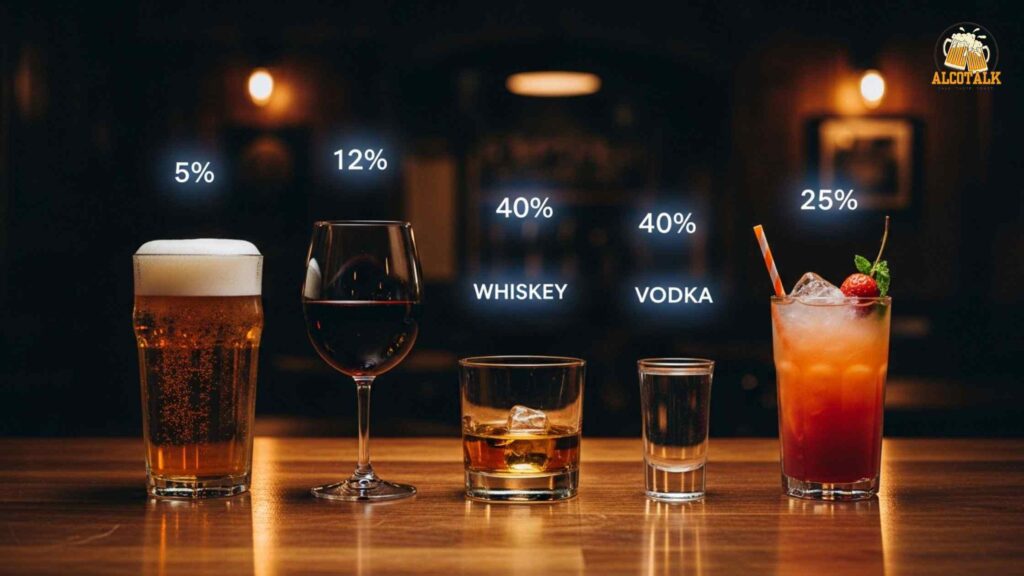
Picture this: an elixir so wild, one drop could spark a bonfire. People have been drinking stuff like that forever—sometimes to forget, sometimes hoping for some kind of revelation. And right there on the label, lurking in tiny print, is the ABV—alcohol by volume. That number doesn’t just tell you how strong your drink is.
It sets the mood, the pace, the whole vibe of the night. Beer’s gentle fizz, whiskey’s velvet punch, cocktails that taste like anything but trouble—the percentages behind them all weave the story.
So let’s wander through the world of alcohol: sidestep the snooze-fest, dig up the strange bits, and figure out what those numbers on the bottle really mean. Because knowing what’s really in your glass? That’s the difference between a legendary night and one you’d rather forget.
Everyday Spirits: The Quiet Power of Common Drinks
Think about a cozy pub—dim lights, foamy beer, a little whiskey shining in the glass. Here, ABV isn’t shouting; it’s low and steady, shaping memories one sip at a time.
But if you look back, you’ll find odd stories: Vikings watering down their ale so they didn’t lose their minds, sailors drinking rum strong enough not to spoil on endless trips across the sea. These aren’t just numbers; they’re the battlegrounds where taste and strength try to get along.
1. Alcohol percentage in beer
Beers are usually pretty mellow—4 to 6 percent, give or take. Nothing too wild. But there are always exceptions. Some craft beers, like imperial stouts, can hit 12 percent. On the flip side, Belgian lambics might come in at just 2 percent, not far off from the “small beer” medieval peasants drank—enough to quench your thirst, not enough to knock you out.
In India, lagers like Kingfisher usually land between 4.8 and 8 percent, but during the war, the government forced brewers to keep it under 5 to keep factory workers in line. Then there’s Finnish sahti, a rye-and-juniper brew that can climb up to 9 percent—a taste of the forest in a glass. Beer isn’t just beer. It’s a constant experiment.
2. Alcohol percentage in whisky
Whisky (or whiskey, if you want to start a fight) is a different animal. Most bottles sit at 40 to 50 percent ABV, but it gets wilder. Scotch single malts usually sit around 43, but bourbon can hit 60 if you grab a cask-strength bottle.
Back in Prohibition days, bootleggers amped things up to 55 percent to cover up lousy batches. In Japan, Yamazaki hovers at 46, but some rare releases blow past 63, like the almost mythical Karuizawa.
In India, you’ll find whiskies like Indri at 46 percent, and by law, nothing sold can dip below 42.8. Every sip of whisky is a history lesson—sometimes smooth, sometimes a punch in the chest.
3. Vodka alcohol percentage
Vodka’s trick is pretending to be plain. Most bottles come in at a straight 40 percent, nothing fancy. But go hunting, and you’ll find bottles like Poland’s Spirytus Rektyfikowany—96 percent, so strong it’ll strip paint.
Russian riverboats used to carry vodka at 45 percent, just so it wouldn’t freeze. Absolut in Sweden? Usually 40, but there are overproof versions at 50 percent if you know where to look.
Here’s a weird one: during the Cold War, Soviet scientists made vodka at 75 percent for cosmonauts—something they only admitted years later. Vodka looks innocent, but it’s got some wild stories behind that clear face.
The Fiery Frontiers: Extremes, Exotics, and Earth’s Wildest Drinks
Step outside your usual bar menu and you’ll tumble into a world of spirits that don’t just test limits—they laugh at them.
These days, Balkan brandies crank things up past 70 percent—made from plums and, honestly, probably a few grudges, too. Around the world, alcohol content swings wildly: Portugal’s port wines settle around 20 percent, but then you’ve got Ethiopian tej, a honey wine that sits somewhere between 8 and 14 percent.
These aren’t your usual drinks. They’re the misfits, the ones that redraw the edges of what we think booze can be.
4. Highest alcohol percentage drink
Sitting at the top of the pile is Spirytus Stawski from Poland—an almost mythical spirit at 96 percent ABV. It even outdoes Everclear’s 95 percent American bravado. Spirytus is distilled three times from wheat, and at 192 proof, it’s basically liquid fire.
Not for the faint of heart. Back in 18th-century Sweden, “brännvin” hit over 90 percent to help folks survive Baltic winters—Vikings’ descendants actually traded the stuff. And then there’s absinthe, that infamous green spirit, which can reach 89 percent in Switzerland.
Turns out, the wormwood stories were overblown, but this stuff still packs a punch. For something really strange, look at Schorschbock 43 from Bavaria—a 43 percent beer that tastes more like moonshine, brewed in secret just to mess with tradition. The highest-proof drinks aren’t just about strength. They’re about guts, and maybe a bit of foolishness.
5. Alcohol percentage of all drinks chart
Picture it: a chart running from mellow to mind-blowing. Beers usually start at 4 to 8 percent. Wines come in at 11 to 14, with fortified wines jumping to 20. Regular spirits land at 40 to 50. Liqueurs hover between 15 and 30. Cocktails? They’re all over the place.
| Drink Type | Typical ABV Range | Exotic Edge |
| Beer | 4-6% | 43% (Schorschbock) |
| Wine | 12% | 24% (Fortified Port) |
| Whisky | 40-50% | 63% (Karuizawa) |
| Vodka | 40% | 96% (Spirytus) |
| Cocktails | 15-30% | 50% (Zombie) |
| Liqueurs | 20-30% | 70% (Chartreuse VEP) |
6. What is the highest percentage of alcohol that is safe to drink
Here’s the thing: “Safe” doesn’t just mean a number on a bottle. It’s how much you drink that really matters. Technically, you can buy 96 percent alcohol, but drinking even a little can be dangerous.
Most health experts say men shouldn’t go above 14 units of alcohol a week—a unit is 8 grams of pure alcohol, or about 25 ml of a 40 percent spirit. For women, it’s half that. That works out to two shots of regular-strength booze a day, if you’re careful.
But with the really strong stuff, like 70 percent Balkan rakia, “safe” drops to maybe a single shot—if that. And just for the record, Arctic explorers once drank 75 percent naval rum to fight off the cold, but that’s more survival than celebration. If you want to stay out of trouble, stick to spirits at 40 percent or less.
Go higher and you’re flirting with danger, no matter how fancy the bottle looks.
Conclusion
In the end, chasing the strongest drink isn’t the point. It’s about enjoying what’s in your glass and knowing your limits. From easygoing beers to cocktails with a kick, these drinks open doors to both fun and risk.
Know what you’re drinking, take it slow, and let your stories last longer than your hangover. Cheers—or maybe, take care. That’s up to you.


